


Jump to a section in this buyer guide
By Shree Salasar Balaji Enterprise (SSBE)
Choosing between liquid glucose manufacturers in India starts with a practical question: will the syrup perform consistently in your product, on your production line, and throughout your supply schedule?
For a confectionery producer, that may mean controlling unwanted sugar crystallisation. For a bakery, it may mean achieving the right filling consistency. For an importer, it also means matching the agreed specification, packaging and shipment documents to the needs of the receiving market.
Shree Salasar Balaji Enterprise combines liquid glucose manufacturing and sourcing from partner manufacturers. Buyers can contact SSBE to discuss the required grade, application, order quantity and delivery destination. This guide explains how to compare options and prepare an enquiry that produces a useful, comparable quotation.
Need to discuss a requirement now? Email support@ssbexport.com, message us on WhatsApp: +919673481000, or visit www.ssbexport.com.In this guide
- What is liquid glucose?
- Manufacturers, suppliers and exporters: understand the supply route
- How liquid glucose is made
- Liquid glucose applications in food manufacturing
- Liquid glucose specifications: what should buyers compare?
- How to assess a liquid glucose supplier before a bulk order
- What affects liquid glucose prices in India?
- Packaging, storage and export planning
- Discuss your liquid glucose requirement with SSBE
- Frequently asked questions
- Start your liquid glucose enquiry
What is liquid glucose?
Liquid glucose, also called glucose syrup, is a concentrated solution of sugars obtained by breaking down starch. Commercial grades contain a mixture of glucose and other saccharides, rather than simply pure glucose dissolved in water. The degree of starch breakdown and the resulting sugar profile help determine the syrup’s characteristics. Cargill’s glucose syrup overview explains why grades differ in solids content and composition.
It is commonly supplied as a thick, clear to pale-yellow syrup. Indian production can use raw materials such as corn or rice, depending on the manufacturing process and product. Ask for the starch source when it matters to your purchasing specification or label requirements. Gulshan Polyols’ liquid glucose product information describes these raw materials and the syrup’s appearance.
For procurement teams, the important distinction is between a product name and a product specification. Two offers labelled “liquid glucose” may have different solids, sugar profiles, colour limits or packaging. Approve the actual grade you intend to purchase.
Manufacturers, suppliers and exporters: understand the supply route
When evaluating liquid glucose manufacturers in India, establish who makes the product and who takes responsibility for the order.
| Supply role | What to establish before ordering |
|---|---|
| Manufacturer | Which facility produces the proposed grade, and who releases each batch? |
| Supplier or sourcing partner | Which manufacturer and product specification will be used for your order? |
| Exporter | Who coordinates packing, shipping documents and the agreed delivery arrangements? |
| Business handling multiple roles | Whether the quotation covers its own production or an identified partner’s production. |
A business may perform more than one role. SSBE handles both manufacturing and sourcing, so the proposed supply route should be clarified for the particular grade and order.
This conversation helps make future deliveries easier to manage. Record the approved source and agree how any proposed change of manufacturing facility or grade will be communicated. A repeat order should refer to the approved specification, not only the same commercial product name.
How liquid glucose is made
At a broad level, starch is hydrolysed into smaller carbohydrate molecules, and the resulting syrup is purified and concentrated. Manufacturers control the conversion and finishing stages to obtain the intended product characteristics. The exact process varies by facility and grade. Gulshan Polyols describes hydrolysis, purification and concentration in its production overview.
For a buyer, understanding this process helps explain why the raw material alone does not define quality. A corn-based syrup still needs a clear specification for solids, dextrose equivalent and other agreed parameters. Ask the proposed supplier to connect its process controls to the properties your finished product requires.
Liquid glucose applications in food manufacturing
Liquid glucose is used across confectionery, bakery, ice cream, dairy and fruit preparations. These application categories appear in Cargill’s food glucose syrup information. The purchasing decision should then narrow from the application category to your recipe and process.
Confectionery, candies and toffees
Glucose syrups can help manage sweetness and texture in confectionery formulations. Their ability to limit unwanted sugar crystallisation is one reason they are used in sweets. Suppliers offer different syrup profiles to suit different products. Cargill’s confectionery sweetener information discusses customised functional properties, while Gulshan Polyols identifies anti-crystallisation as a liquid glucose function.
In a trial, evaluate the results that matter to your line: cooking behaviour, finished texture, colour and consistency after storage. Define acceptable results before comparing samples, so the purchasing team and product team judge each option against the same criteria.
Bakery fillings and sweet preparations
For bakery applications, start by explaining where the syrup will be used. A filling, a glaze and a baked recipe present different purchasing questions. Ask your technical team to evaluate sweetness, handling, consistency and performance through the actual production process.
A successful small sample is a useful first step. Follow it with a production trial when the commercial risk justifies it, using the intended equipment and the same grade proposed for regular supply.
Ice cream, dairy desserts and fruit products
For frozen desserts and fruit preparations, specify the finished-product target rather than asking for a generic “best quality” syrup. Share the intended application, the current approved grade if available, and the performance problem you are trying to solve.
Compare trial batches under the same conditions. Keep a record of the sample identification, recipe, processing conditions and observations. This gives both buyer and supplier a concrete basis for discussing adjustments.
Liquid glucose specifications: what should buyers compare?
The following table is a buyer evaluation checklist, not an SSBE product specification. Numerical limits must be agreed for the offered grade and intended use.
| Parameter | What it tells you | What to request |
|---|---|---|
| Dextrose equivalent (DE) | An indicator of the extent of starch hydrolysis. | Target range, test method and reporting basis. |
| Dry solids | The proportion of material other than water. | Agreed percentage range and method. |
| Sugar profile | The distribution of individual sugars and larger saccharides. | Grade-specific data if relevant to your formulation. |
| Appearance and colour | Whether the syrup meets the agreed visual requirement. | Defined description and any numerical colour limit. |
| pH | Acidity or alkalinity under specified test conditions. | Range plus sample dilution and method. |
| Sulphur dioxide | A parameter that may be specified for the proposed grade. | Test result and an appropriate agreed limit. |
| Ash and other chemical parameters | Additional properties covered by the product specification. | Relevant limits and methods. |
| Microbiological parameters | Results against the agreed microbiological criteria. | Organisms tested, limits, methods and reporting units. |
| Traceability | The connection between the goods and their records. | Batch number, manufacturing date and matching COA. |
Published manufacturer documents demonstrate why one universal table is insufficient. For example, Sukhjit’s brochure lists a liquid glucose DE range of 38–45, while Gulshan’s product page lists 36–44. These are examples from those manufacturers, not a promise about any SSBE grade. Obtain a current technical data sheet for the actual offer. Sukhjit product brochure; Gulshan product specification.
What does DE mean?
Dextrose equivalent expresses reducing sugar content relative to dextrose on a dry basis. It helps describe the extent to which starch has been broken down. A 42 DE syrup does not mean the syrup contains 42% pure glucose. Roquette’s explanation of DE gives the technical definition.
Use DE to narrow your selection, then assess the complete specification and trial performance. Ask for the sugar profile when your technical team needs more detail than the DE value provides.
Read the test conditions as well as the number
A comparison can be misleading when the reporting conditions differ. For instance, a pH result should identify the solution preparation used for testing. The same care applies to measurement units and whether a result is expressed on a dry basis.
When a quotation mentions Brix but your specification states dry solids, ask the supplier to explain the measurement method and reporting convention. Resolve this before approval, rather than assuming the two labels are interchangeable in every document.
How to assess a liquid glucose supplier before a bulk order
1. Begin with a written requirement
Share the application, required grade, monthly or shipment quantity, destination and preferred packing. If you already use an approved syrup, provide its specification rather than relying on a product nickname.
Separate essential requirements from preferences. A maximum colour limit may be essential to your recipe, while a preferred drum size may be negotiable. Making that distinction helps a supplier propose a relevant option.
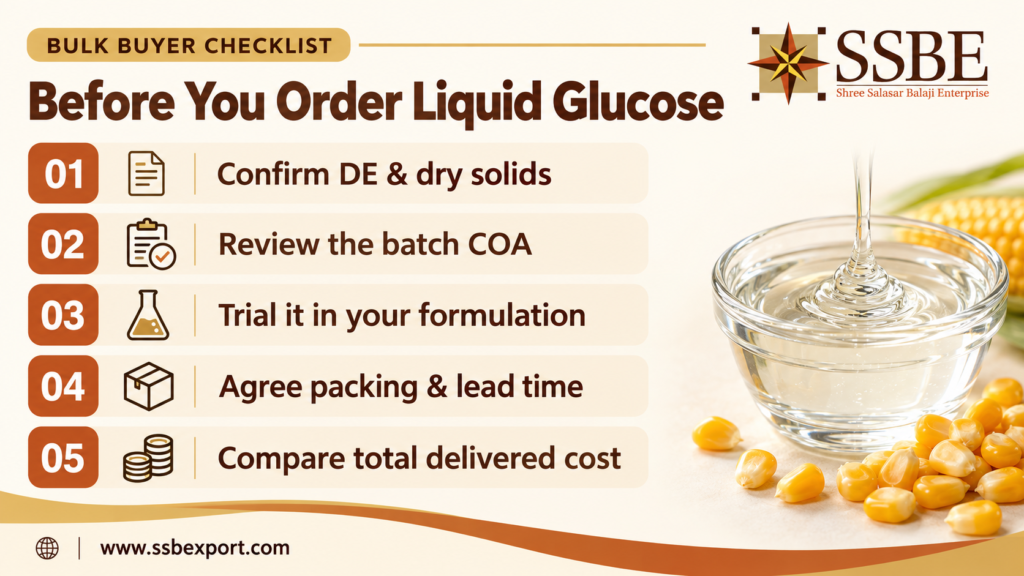
2. Review the technical data sheet and batch COA
A technical data sheet describes the grade. A Certificate of Analysis, or COA, records results for an identified batch. Ask for both during qualification and establish how the COA for the dispatched material will be supplied.
Check that the product identity and batch details agree across records. If a parameter is critical to your process, confirm whether it is tested and reported for each batch or managed through another documented control.
3. Check documents against the actual facility and product
Ask for the licences, certifications, declarations and other records relevant to your purchase. Review their validity, scope and connection to the proposed manufacturing facility. A certificate for a different product or site does not answer every question about the offered syrup.
For Indian food requirements, use the current FSSAI product standards resources as a starting point and have the responsible quality team establish what applies. Export buyers should also identify destination-specific requirements before finalising the specification.
4. Approve a traceable sample
Record the sample’s grade and batch identification. Agree the trial criteria, complete the evaluation, and keep the results with the approved specification.
If your team rejects a sample, explain the observed issue precisely. “Too difficult to pump under our receiving conditions” provides a clearer starting point than “quality not suitable.” Specific feedback makes the next technical discussion more productive.
5. Agree the repeat-order process
Before moving to regular supply, establish who handles technical questions, order changes and complaints. Confirm how changes to grade, source or packing will be approved. These details belong in the purchasing arrangement, where both parties can refer to them later.
What affects liquid glucose prices in India?
A useful quotation is tied to a defined grade and delivery basis. Asking only for the “lowest liquid glucose price per kg” can produce offers that are difficult to compare.
Request a breakdown covering the product specification, quantity, packing, freight basis, applicable charges, payment terms, dispatch timing and quotation validity. For export orders, specify the named destination or port and clarify the responsibilities included in the quoted trade term.
Compare the cost of dry solids
Here is an illustrative calculation, not a current market quotation. Assume two syrups are equally suitable for the application and compare only their product price and dry solids:
| Illustrative offer | Price per kg of syrup | Dry solids | Cost per kg of dry solids |
|---|---|---|---|
| A | ₹40.00 | 80% | ₹40.00 ÷ 0.80 = ₹50.00 |
| B | ₹42.00 | 85% | ₹42.00 ÷ 0.85 = ₹49.41 |
Offer B costs more per kilogram of syrup but slightly less per kilogram of dry solids. This calculation helps compare concentration; it does not prove that B is the better formulation choice.
Add the actual freight, handling and other applicable costs, then consider trial performance and practical receiving requirements. The strongest commercial offer is the one that meets the approved requirement at an acceptable total cost.
Packaging, storage and export planning
Discuss packaging alongside the product specification. The format affects receiving equipment, unloading, storage space and how the syrup will be transferred into production.
Manufacturer literature includes drum and bulk-tanker supply formats, but availability depends on the source and order. Sukhjit’s brochure, for example, describes barrels and bulk tankers. Confirm the packing proposed in your own quotation. Sukhjit packaging information.
Before dispatch, agree:
- Packing material, net weight and seal arrangements.
- Batch identification and required label information.
- Palletisation or other handling requirements, where applicable.
- Receiving and unloading arrangements at the destination.
- Manufacturer-stated storage conditions, shelf life and any instructions after opening.
- Any approved warming or transfer procedure needed for your equipment.
Do not assign a universal shelf life to liquid glucose. Use the information supplied for the specific grade and packaging, and plan stock rotation around it.
For export enquiries, agree the document list before shipment planning. Depending on the transaction and destination, the discussion may include a commercial invoice, packing list, transport document, certificate of origin, COA and any additional documents required by the buyer or relevant authority. Have your importer or customs representative confirm the applicable requirements rather than treating a generic checklist as complete.
Discuss your liquid glucose requirement with SSBE
Shree Salasar Balaji Enterprise works with agro products and food ingredients, with company information available on the SSBE About Us page. For liquid glucose, our business covers both manufacturing and sourcing from partner manufacturers.
The starting point for your enquiry is the product you need to make. Tell us the application and the specification you want to achieve, then include the quantity and destination so the commercial discussion can address the same requirement.
Ask us to confirm the proposed supply source, available grade, technical documentation, packing, minimum order quantity and lead time for your enquiry. These details should be settled in the quotation and order confirmation.
Send these details for a useful quotation
- Application: confectionery, bakery, dairy, fruit preparation or another intended use.
- Specification: required DE, dry solids and other critical limits, or your existing approved data sheet.
- Quantity: trial quantity, order quantity and estimated repeat demand.
- Destination: delivery city or destination country and port.
- Packing: preferred format and any receiving constraints.
- Documentation: required declarations, test reports or certificates.
- Timing: target dispatch or arrival window.
If you do not yet have a specification, describe the application and the performance you need. That gives the technical discussion a useful starting point before you approve a sample or place an order.
Frequently asked questions
How do I choose between liquid glucose manufacturers in India?
Compare the offered specification, manufacturing source, batch documentation, sample performance and delivery arrangements. Use a common written requirement so each quotation covers the same need. Price becomes more meaningful once technical suitability is established.
Is liquid glucose the same as corn syrup?
Corn syrup is glucose syrup made from corn starch. Glucose syrup can also come from other starch sources, so confirm the raw material if it matters to your specification. Do not infer the source from a generic product name. Cargill identifies corn starch as the source for its referenced product; Gulshan describes corn and rice inputs.
Which DE should I use for confectionery?
There is no single grade suitable for every confectionery recipe. Start with the specification of a successfully approved ingredient or ask for a grade proposal based on your product and process. Confirm suitability through a controlled trial.
Can I substitute one liquid glucose grade for another?
Treat a grade change as a technical change. Compare the complete specifications and evaluate the proposed material before routine production. A similar product name or DE value is not sufficient evidence that the substitution will meet your finished-product requirements.
What is the minimum order quantity?
The minimum order quantity should be confirmed for the available grade, packing and supply route. Send SSBE your trial and commercial quantities so the enquiry can be reviewed against the proposed arrangement.
Does SSBE manufacture liquid glucose or source it?
SSBE handles both manufacturing and sourcing from partner manufacturers. Ask the team to confirm the source, grade and documentation applicable to your quotation.
How can I request a liquid glucose quotation?
Send your application, specification, quantity, packing preference and destination to support@ssbexport.com, or message WhatsApp: +919673481000. Include your target delivery timing and any required documents.
Start your liquid glucose enquiry
Choosing liquid glucose manufacturers in India becomes easier when the conversation begins with measurable requirements. Match the grade to the application, evaluate a traceable sample, and agree the commercial and delivery details before committing to bulk supply.
Contact Shree Salasar Balaji Enterprise to discuss your liquid glucose requirement. Share your specification, quantity and destination to begin a focused quotation discussion.
Email: support@ssbexport.com
WhatsApp: +919673481000
Website: www.ssbexport.com

Shree Salasar Balaji Enterprise · support@ssbexport.com · WhatsApp +919673481000
Continue your ingredient research: Maltodextrin grades and purchasing checklist · Corn grits buyer guide · Request a liquid glucose quotation