Choosing the right corn grits manufacturers in India starts with understanding what your business needs from the product. Granulation, moisture, consistency, packaging and delivery arrangements all deserve attention before a bulk order is placed.
For a snack manufacturer, the priority may be a grade that performs consistently during extrusion. A breakfast cereal producer may need material suited to a particular flaking process. A brewery will have its own ingredient specifications and approval requirements. Although all three businesses may purchase corn grits, their requirements can differ considerably.
Shree Salasar Balaji Enterprise (SSBE) manufactures and supplies corn grits through its published product range and welcomes enquiries from buyers looking to discuss grades, specifications and bulk purchasing requirements.
This guide explains what corn grits are, how to compare suppliers, which specifications to review and what information to include when requesting a quotation.
Contact Shree Salasar Balaji Enterprise
- Website: www.ssbexport.com
- Email: support@ssbexport.com
- WhatsApp: +919673481000
What Are Corn Grits?
Corn grits are granular particles produced by milling maize. They are also commonly called maize grits.
In degerminated grits production, processing separates much of the germ and outer material from the starchy endosperm. The remaining material is milled and graded for its intended application. Bühler’s degermination overview describes how this stage separates kernel components and supports the production of lower-fat material.
The term “corn grits” alone does not define the complete product. Buyers still need to establish the particle-size distribution, composition, moisture requirement and intended use.
For this reason, a useful purchasing enquiry goes beyond asking for “yellow corn grits.” It describes the application and provides the specification against which the product will be evaluated.
Corn Grits, Corn Flour and Broken Maize
These product descriptions should be clarified before ordering.
| Product | What buyers should confirm |
|---|---|
| Corn grits | Granulation, acceptable fines, processing method and intended application |
| Corn flour or maize flour | Fineness, processing route and suitability for the recipe |
| Broken maize | Particle distribution, degree of processing and intended food or feed use |
| Flaking grits | Requirements for the buyer’s particular cereal or flaking process |
Terminology can also vary between markets. For example, an enquiry for “corn flour” should clarify whether the buyer means milled maize flour or corn starch.
A technical specification or approved reference sample provides a clearer starting point than a product name alone.
Why Buyers Consider Corn Grits Manufacturers in India
India has an established maize-growing base. APEDA identifies major producing states including Madhya Pradesh, Karnataka, Bihar, Maharashtra and Telangana. It also highlights production across the year and access to seaports among India’s supply advantages. See APEDA’s maize overview.
For procurement teams, these factors make India a relevant sourcing origin for maize-based ingredients.
The next step is to evaluate individual suppliers. Buyers should compare the actual material offered, its supporting documentation, current availability, packing arrangements and delivery terms.
A practical assessment should answer questions such as:
- Does the proposed product match the required application?
- Can the supplier provide a clear, current specification?
- How will samples be evaluated and approved?
- What information will identify each commercial lot?
- What packing and delivery arrangements are included in the quotation?
- How will repeat orders and specification changes be managed?
The strongest purchasing decision combines product suitability with a clear understanding of the supply arrangement.
Choosing Corn Grits for Your Application
Start the discussion with the finished product you intend to manufacture. Bühler’s corn and maize processing guide distinguishes snack grits, brewery grits and flaking grits as different processing outputs.
Corn Grits for Extruded Snacks
Snack manufacturers should evaluate the proposed material using their own formulation and equipment.
Record the incoming product’s sieve profile and moisture together with the operating conditions used during the trial. This creates a useful reference when assessing future deliveries.
Ingredient characteristics and processing conditions work together. Clextral’s snack extrusion guide identifies particle size, moisture, native fat and operating conditions as variables relevant to product development.
Before approving a sample, define the results your team expects. These may include acceptable appearance, texture, output and consistency.
A documented trial is more useful than an informal observation that a sample “looks suitable.”
Corn Grits for Breakfast Cereals and Flakes
Cereal manufacturers should explain their production route when requesting a grade.
A conventional flaking process may have different requirements from an extruded cereal process. The description “coarse grits” should therefore be supported by the buyer’s technical requirements.
Ask the supplier to identify the proposed material and provide sufficient sample for evaluation. Review the resulting finished product against your own standards for appearance, dimensions and process performance.
Corn Grits for Brewing
Brewing enquiries should include the brewery’s ingredient specification and approval requirements.
Request the compositional, granulation and quality information your technical team needs to assess the material. A product described as “brewery grade” should still be reviewed against the brewery’s own specification.
Agree the required reports and trial procedure before finalising a commercial order.
Corn Grits for Other Food Applications
For mixes, coatings and other formulated products, describe the role the maize ingredient plays in the recipe.
Explain whether the material will undergo further milling, blending or cooking. This helps the supplier understand the proposed use and identify a suitable product for evaluation.
How Corn Grits Are Manufactured
A general dry-milling process includes cleaning, separation of kernel components where required, milling, and sieving or grading. The precise route depends on the equipment and intended product.
The main stages serve different purposes:
- Cleaning: Prepares incoming maize by removing unwanted material.
- Degermination, where required: Separates germ and outer material from the endosperm.
- Milling: Reduces the material toward the intended granulation.
- Sieving and grading: Separates particle fractions.
- Final checks and packing: Confirms the agreed release requirements and identifies the finished lot.
These general process distinctions are illustrated in Bühler’s corn and maize processing guide.
When evaluating a supplier, ask how its own process controls these stages. Establish where the material is processed, who approves the finished specification and how production records relate to the delivered lot.
Corn Grits Specifications Buyers Should Compare
A useful specification states the parameter, the acceptance requirement and the assessment method.
The following table is a buyer’s enquiry checklist. The final requirements should be agreed for the particular product and order.
| Parameter | Information to request |
|---|---|
| Product identity | Maize type, supplier grade code and intended application |
| Granulation | Sieve openings, units and percentages retained or passing |
| Moisture | Agreed maximum and test method |
| Composition | Application-relevant fat, ash, protein or starch requirements |
| Appearance | Agreed colour and visible-particle criteria |
| Quality testing | Tests and acceptance criteria specified by the buyer’s quality team |
| Lot identification | Batch reference connecting the product, sample and report |
| Packing | Bag material, lining where required, net weight and closure |
| Storage and shelf life | Written guidance for the offered product and packaging |
Request a Sieve Profile
A grade name or a single mesh number may not describe the complete particle distribution.
Request the sieve system or opening sizes and the proportion passing or retained at the agreed points. Ask suppliers to present this information in the same format so their offers can be compared.
Two products described as “medium grits” may still need separate production trials.
If your business already uses an approved product, include its written specification with the enquiry. This gives prospective suppliers a more precise target.
Review the Certificate of Analysis
A Certificate of Analysis, or COA, records reported test results for identified material.
When reviewing a report, check:
- Product name and grade.
- Lot or batch reference.
- Test date.
- Units and test methods.
- Results against the agreed requirements.
Establish whether the report relates to the sample, the offered commercial material or a general example of the supplier’s product.
Your quality team should determine the appropriate testing programme for the application and market. Agree which documents are needed for approval and which must accompany commercial deliveries.
Corn Grits from Shree Salasar Balaji Enterprise
SSBE’s published corn grits catalogue lists Corn Grits 101, 108, 109 and 115. The catalogue currently lists 13% maximum moisture for these products.
These numbers are supplier product identifiers. Buyers should request the current technical details of the proposed grade instead of assuming that the code represents a universal particle size or application.
When contacting Shree Salasar Balaji Enterprise, discuss:
- Your finished product and processing route.
- Required granulation.
- Quality parameters.
- Sample requirements.
- Order quantity.
- Packing and delivery destination.
The final purchase should refer to the specification agreed for the order. The online catalogue provides a starting point, while the current quotation establishes what is being offered for your requirement.
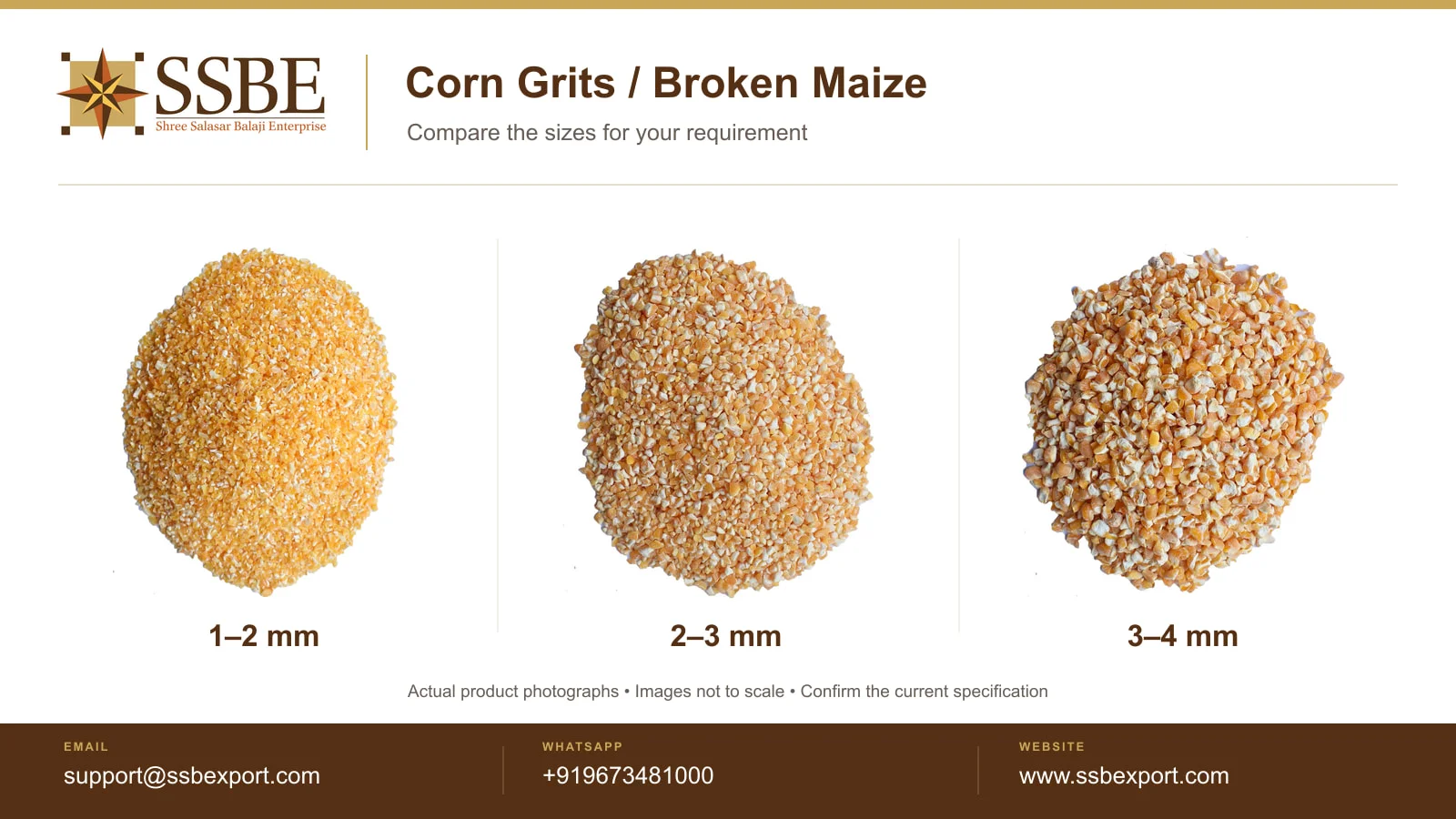
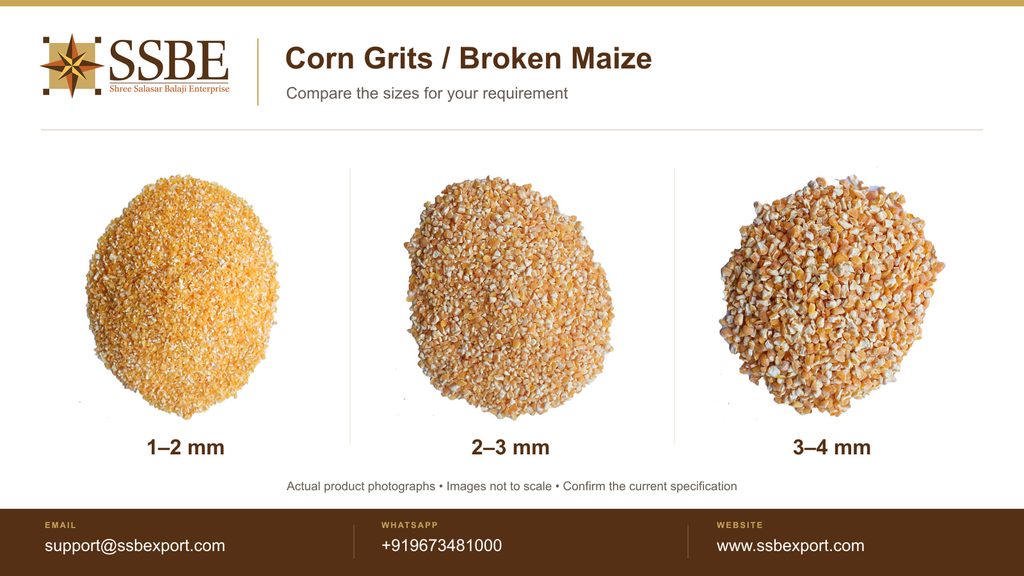
Product Sizes Shown in SSBE Photographs
The supplied SSBE product photographs identify:
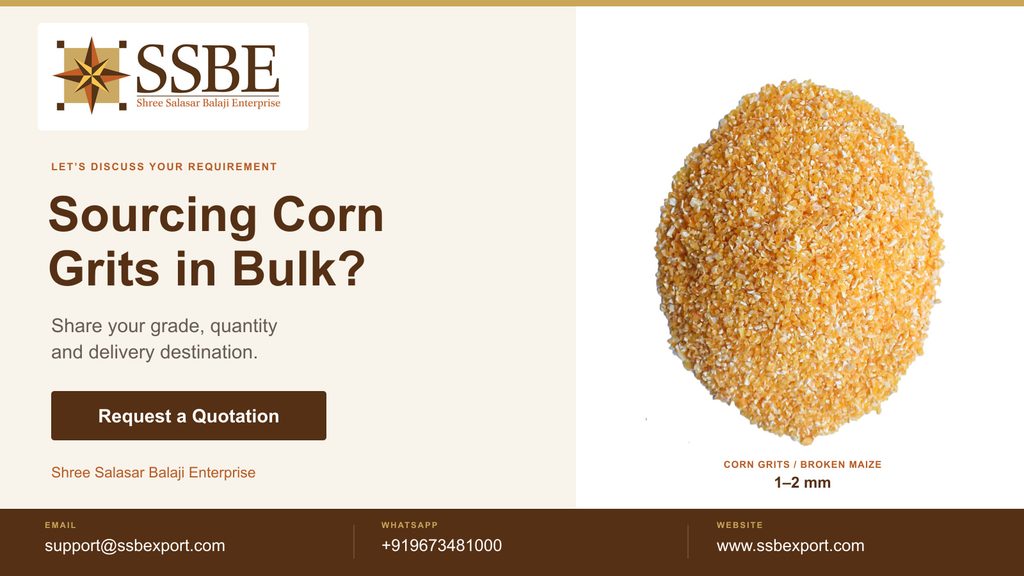
- Corn Grits 101
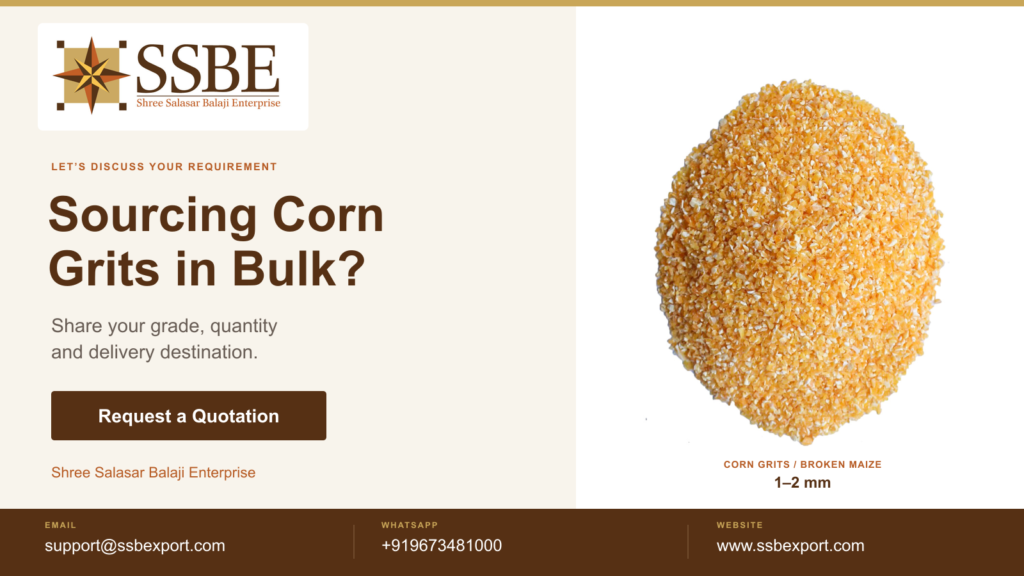
- Corn grits / broken maize: 1–2 mm
- Corn grits / broken maize: 2–3 mm
- Corn grits / broken maize: 3–4 mm
Use the relevant description when making an enquiry.
Photographs help buyers discuss product appearance, but displayed images are not a measurement reference. Request the current sieve profile and a representative sample before approval.
The photographed size descriptions do not establish a size mapping for grade codes 101, 108, 109 or 115.
How to Evaluate Corn Grits Manufacturers in India
A structured comparison helps buyers assess product suitability and the working relationship behind the supply.
1. Establish Responsibility for the Product
Ask whether the company operates the processing facility, sources through a partner mill or coordinates another supply arrangement.
Identify the processing location and the organisation responsible for quality release. Establish who will answer technical questions and investigate any discrepancy.
Clear responsibilities help purchasing, production and quality teams work with the supplier effectively.
2. Compare Equivalent Offers
Send shortlisted suppliers the same enquiry.
Specify the application, product requirements, quantity, packing, destination and delivery basis. Ask each supplier to highlight any difference between its offer and your request.
A comparison sheet becomes more useful when exceptions are visible. A general description such as “premium quality” provides little basis for evaluating two different products.
3. Approve a Representative Sample
Agree how the sample relates to the proposed commercial supply.
Label it with the supplier name, product code and reference number. Retain part of the sample after testing so your team has a physical reference.
For production trials, record the formulation, operating conditions and acceptance criteria. This helps explain why the material was approved and provides a baseline for later deliveries.
4. Review Supporting Documents
Request documents relevant to your procurement process and check their scope.
For any certification supplied, review the named organisation, facility, covered activity and validity. For product reports, check that the material and lot are clearly identified.
Keep company credentials and product test results within the appropriate parts of the approval process.
5. Confirm Packing and Delivery Details
Agree the bag construction, net weight, markings, handling arrangement and delivery point.
For overseas enquiries, provide the destination country and port at the beginning. Establish the documents needed for that shipment with the supplier and your logistics team.
Record the agreed requirements in the order documents.
6. Agree How Discrepancies Will Be Handled
Define the receiving checks before the order is dispatched.
Establish how your team should report a concern, preserve samples and share supporting records. Identify the people responsible for investigating and responding.
This gives both parties a clear procedure if the delivered material differs from the agreed requirements.
7. Review Repeat-Order Performance
A successful first order is the beginning of a supply relationship.
Track specification compliance, delivery performance, documentation accuracy and communication over subsequent orders. Include feedback from the production team in supplier reviews.
This creates a more complete picture of performance than price comparisons alone.
What Affects Corn Grits Prices in India?
A useful price quotation needs a defined commercial basis.
When requesting a quote, ask the supplier to identify:
- Offered grade and specification.
- Quantity.
- Packing.
- Testing or documentation inclusions.
- Dispatch timing.
- Delivery basis.
- Currency and payment terms.
- Quotation validity.
Compare offers using the costs relevant to your purchase. A price for collection at the supplier’s premises cannot be compared directly with a price that includes delivery to another location.
For example, one offer may have a lower price per tonne but exclude the packing or reports you requested. Another may include those items. Obtain the missing costs and confirm that both products meet the same specification before deciding.
For a current SSBE quotation, share your application or grade, quantity, packing preference and destination.
Packing, Storage and Delivery Planning
Packing should be treated as part of the product specification.
Confirm that the proposed format suits your receiving equipment, handling practices and storage arrangements. Discuss the bag weight, lining, closure and identifying information printed on each unit.
Your receiving team should be able to trace the lot after bags move into storage.
Request written storage conditions and shelf-life information for the offered product. Guidance for another grade or packaging format may not apply to the material you are purchasing.
Plan the order backward from the date it is needed in production. Allow time for:
- Sample evaluation and approval.
- Agreed testing.
- Packing and dispatch preparation.
- Transport.
- Receiving inspection.
Confirm the actual schedule in the quotation and order acknowledgement.
Discuss Your Corn Grits Requirement with SSBE
Shree Salasar Balaji Enterprise offers a published corn grits range through SSB Export.
For buyers evaluating suppliers in India, the product catalogue provides a starting point for discussing material, specifications and purchasing requirements.
If you already have a technical sheet, include it with your enquiry. If you are selecting a grade for a new product, explain the intended application and the requirements your technical team has defined so far.
You can explore the SSBE corn grits range or contact Shree Salasar Balaji Enterprise to discuss current options.
What to Include in Your Enquiry
A complete enquiry should contain:
- Application: Snacks, cereals, brewing or another use.
- Specification: Required granulation and quality parameters.
- Quantity: Initial purchase and expected repeat requirement.
- Packing: Preferred format and bag weight.
- Destination: Delivery city or country and port.
- Timing: Required delivery period.
- Approval needs: Samples, reports and documents requested by your team.
Providing these details gives both sides a clearer basis for discussing suitability, price and next steps.
Frequently Asked Questions
How do I choose between corn grits manufacturers in India?
Compare the proposed specification, representative sample, quality evidence, packing, delivery terms and responsibility for supply. Evaluate the material in your own process before approving a bulk order.
Are corn grits and maize grits the same?
The terms commonly refer to the same type of milled maize product. Confirm the processing method and specification because the name alone does not define granulation, composition or end use.
Which corn grits grade is suitable for snacks?
The appropriate grade depends on your formulation, equipment and target product. Share your requirements, obtain the proposed specification and conduct a trial before approval.
What do Corn Grits 101, 108, 109 and 115 mean?
These are product identifiers listed in SSBE’s catalogue. Request the current technical details of each proposed grade. The numbers should not be treated as universal mesh sizes.
What is the minimum order quantity?
Ask for the current minimum order quantity for your required grade, packing and destination. Include your initial requirement and expected repeat volume.
Can I request a sample before buying in bulk?
Contact SSBE to discuss sample availability, quantity, dispatch arrangements and any applicable charges. Explain what your laboratory or production trial needs.
What documents should I request?
Agree the required specification, test reports, commercial documents and destination-specific documents with the supplier and your relevant teams. Identify which are needed for approval and which should accompany shipment.
How can I get a quotation from Shree Salasar Balaji Enterprise?
Email support@ssbexport.com or send a WhatsApp message to +919673481000 with your application, specification, quantity, packing, destination and required delivery period.
Start Your Bulk Corn Grits Enquiry
When comparing corn grits manufacturers in India, focus on the material your production process needs and the evidence required to approve it.
A clear specification, a representative trial and agreed commercial terms provide a practical foundation for repeat purchasing.
Contact Shree Salasar Balaji Enterprise to discuss your corn grits requirement:
Website: www.ssbexport.com
Email: support@ssbexport.com
WhatsApp: +919673481000
Share your application, grade, quantity and destination to begin your enquiry.
Compare maize products: Corn flour specifications · Broken corn and maize supply · Request a corn grits quotation