India has quietly become one of the most reliable sourcing destinations for corn grits in the global food, beverage, and animal feed industries. From breweries in Africa to snack food manufacturers in the Middle East and cereal producers across Southeast Asia, international buyers are increasingly turning to Indian corn grits manufacturers and exporters for consistent quality, competitive pricing, and dependable supply chains.
If you’re a buyer, importer, or procurement manager searching for a trusted corn grits exporter from India, this guide covers everything you need to know — from manufacturing processes and product grades to shipping logistics and how to choose the right supplier.
At Shree Salasar Balaji Enterprise (SSB Export), we specialize in the manufacturing and export of premium-quality corn grits, corn flour, maize products, and other agro commodities from India to buyers across the world. This article shares our industry insight to help you make an informed sourcing decision.
What Are Corn Grits?
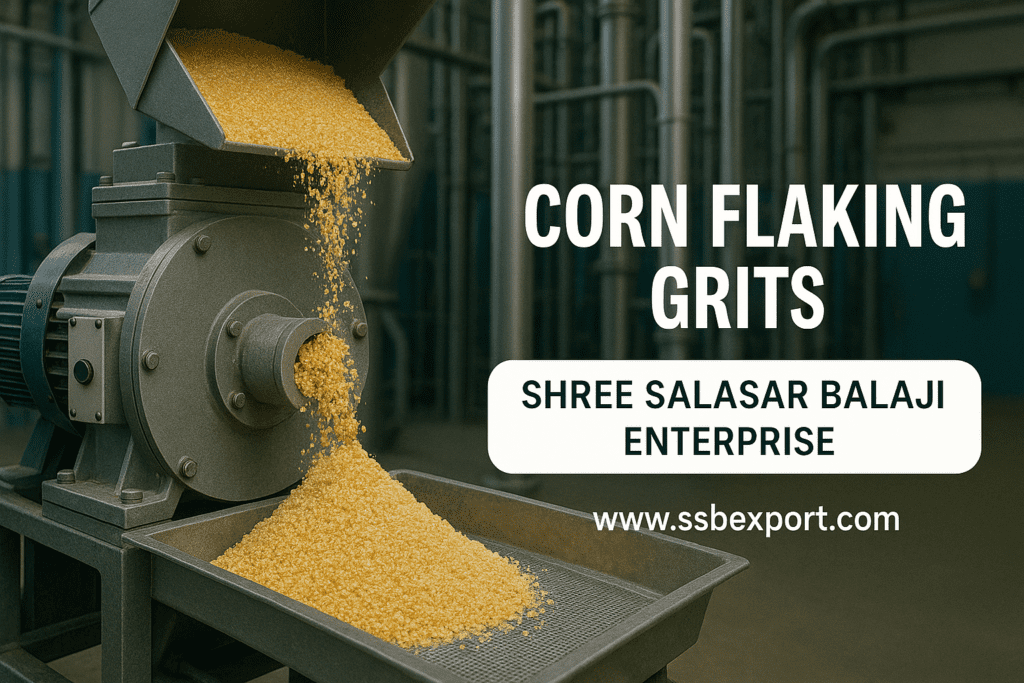
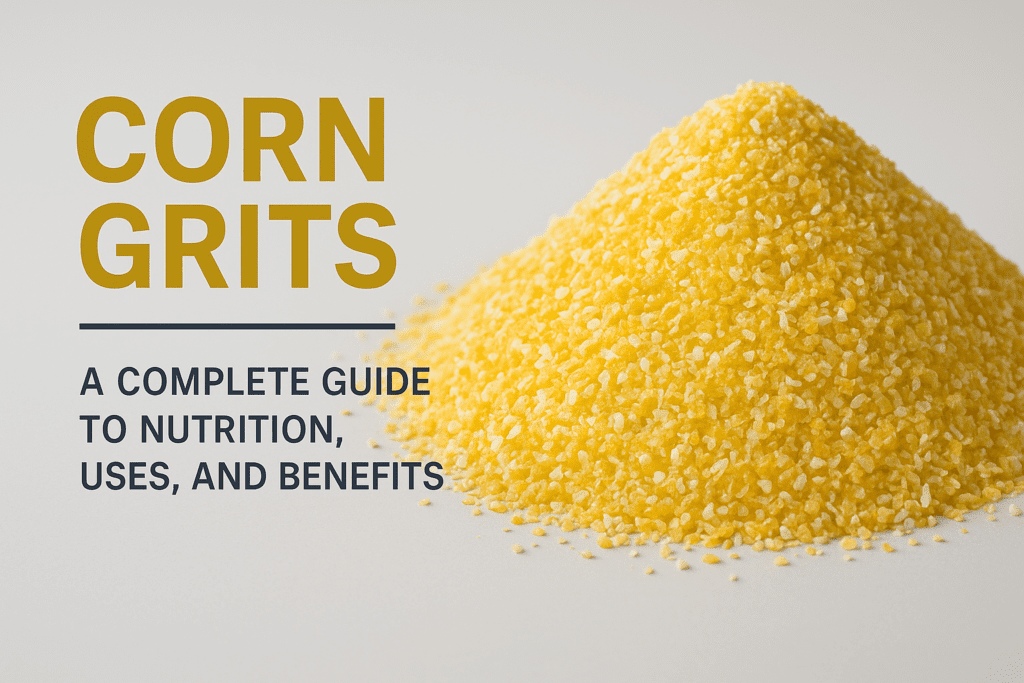
Corn grits are coarsely ground, degermed corn (maize) kernels, processed to remove the bran and germ while retaining the starchy endosperm. The result is a granular product widely used in:
- Brewing industry — as an adjunct in beer production, prized for its high starch content and low fat/oil profile
- Food and snack manufacturing — extruded snacks, breakfast cereals, and porridge products
- Bakery applications — corn bread, tortillas, and specialty baked goods
- Animal and poultry feed — as an energy-dense feed ingredient
- Distilling industry — as a fermentable starch source for alcohol production
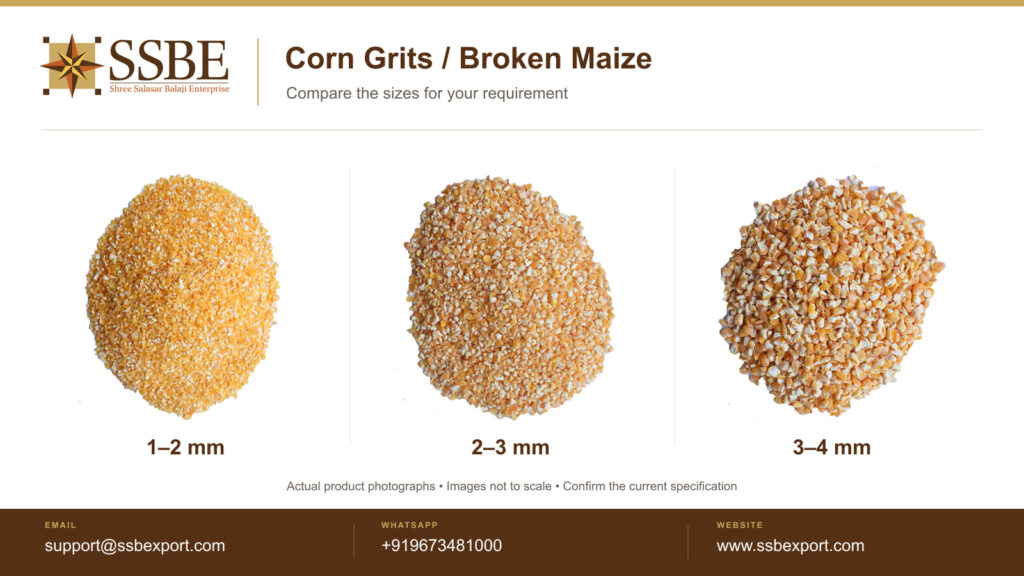
Depending on particle size and processing method, corn grits are typically classified into different mesh sizes and grades — coarse, medium, and fine — to suit the specific requirements of brewers, food processors, and feed manufacturers.
Why India Has Become a Preferred Sourcing Hub for Corn Grits
1. Abundant Raw Material Availability
India is among the world’s largest producers of maize, with major growing belts in Karnataka, Madhya Pradesh, Bihar, Maharashtra, and Andhra Pradesh. This ensures a steady, cost-effective supply of raw corn for grit manufacturing throughout the year.
2. Cost Competitiveness
Lower processing and labor costs, combined with efficient milling infrastructure, allow Indian manufacturers to offer corn grits at prices that are highly competitive against South American and European suppliers, without compromising on quality.
3. Established Export Infrastructure
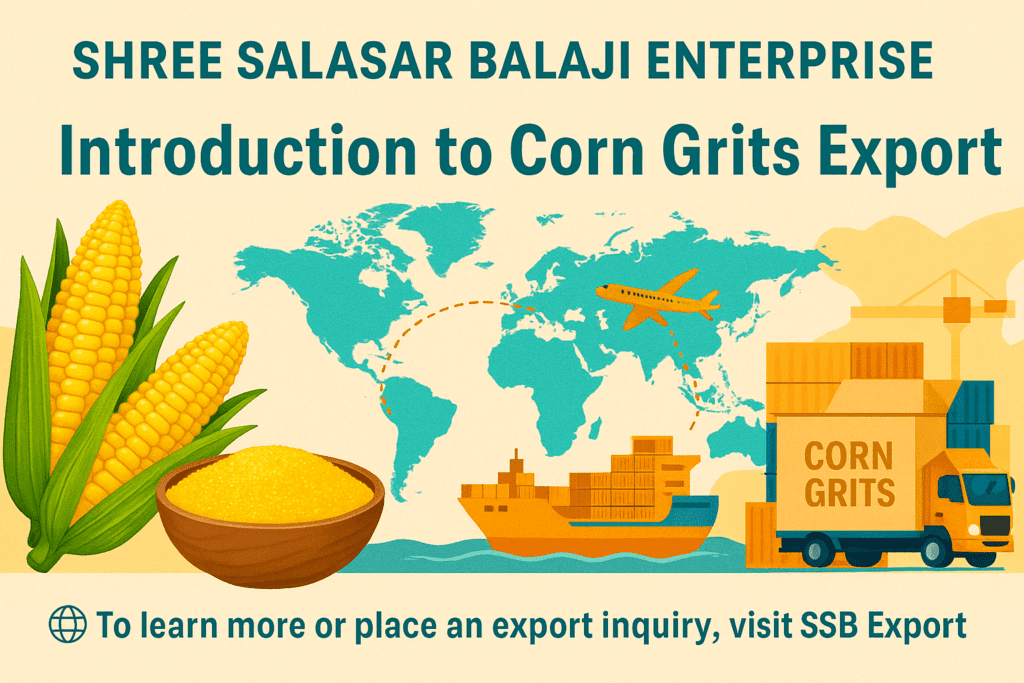
India’s proximity to major ports — including Mundra, Nhava Sheva (JNPT), Kandla, and Chennai — means shorter transit times to key markets in the Middle East, Africa, and Southeast Asia compared to competing origins.
4. Consistent Quality Standards
Reputed Indian exporters follow strict quality control processes, including moisture control, sieve analysis, aflatoxin testing, and microbiological screening, ensuring the product meets international food safety and industry-specific specifications.
5. Flexible Order Quantities
From single container (FCL) trial orders to large-volume multi-container annual contracts, Indian manufacturers are generally more flexible in accommodating a wide range of buyer requirements compared to large industrial suppliers elsewhere.
The Corn Grits Manufacturing Process
Understanding how corn grits are made helps buyers evaluate supplier quality more effectively. The typical process includes:
- Cleaning — Raw maize is cleaned to remove dust, stones, and foreign material
- Tempering — Corn is conditioned with controlled moisture to loosen the bran and germ
- Degerming — The germ and bran are separated from the endosperm using degerminator machines
- Milling and Sizing — The endosperm is milled and passed through sieves to achieve the desired grit size
- Grading — Products are sorted into coarse, medium, and fine grit categories
- Quality Testing — Samples are tested for moisture content, protein, fat, ash content, and microbial safety
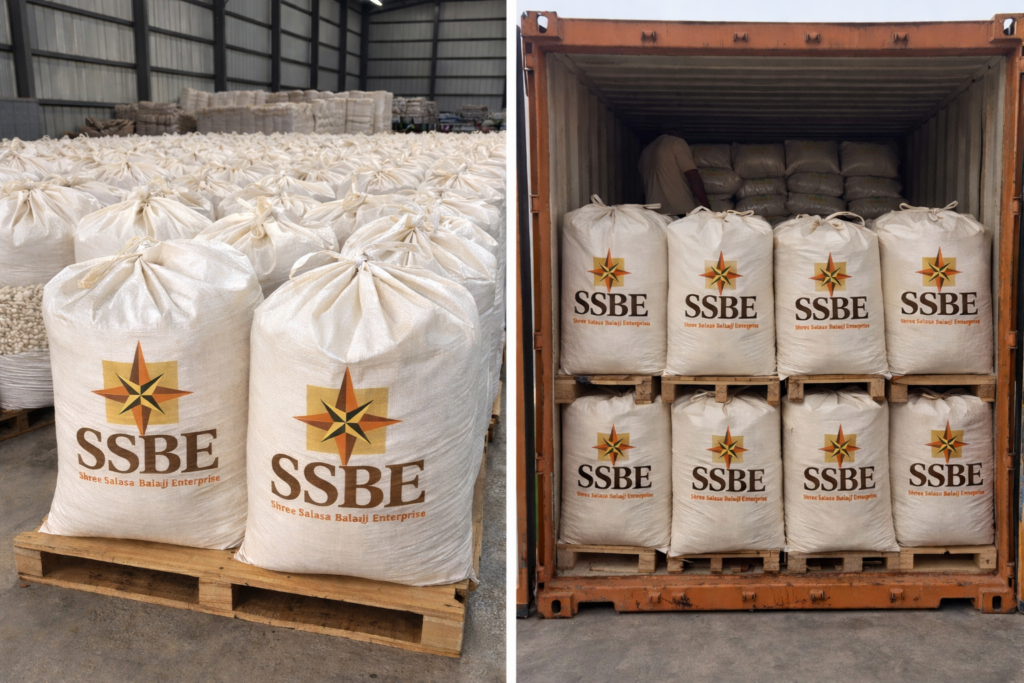
- Packing — Corn grits are packed in food-grade PP bags, laminated bags, or as per buyer specification (typically 25 kg or 50 kg bags, and jumbo bags for bulk orders)
Typical Specifications Buyers Look For
When sourcing corn grits from India, international buyers commonly request the following specifications:
| Parameter | Typical Range |
|---|---|
| Moisture | 12% – 14% max |
| Protein | 7% – 9% |
| Fat | 0.5% – 1.5% (low-fat grits for brewing) |
| Fiber | 1% max |
| Granulation | As per buyer’s mesh size requirement |
| Aflatoxin | Within FSSAI / Codex / buyer country limits |
| Packing | 25 kg / 50 kg PP bags or as per requirement |
A credible exporter should be able to provide a Certificate of Analysis (COA), phytosanitary certificate, and fumigation certificate along with every shipment.
HS Code for Corn Grits Export from India
Corn grits exported from India are commonly classified under HS Code 1103 (Cereal groats, meal and pellets), with 1103.13 being the most widely used subheading for corn/maize grits shipments. Depending on the specific product variant — such as flaking grits used for corn flakes production — HS Code 1104 may also apply. Buyers and importers are advised to confirm the exact HS classification with their exporter and customs broker, as correct classification affects duty rates and import compliance in the destination country.
Key Export Markets for Indian Corn Grits
Indian corn grits manufacturers currently serve a growing list of international markets, including:
- Middle East — UAE, Saudi Arabia, Oman, Qatar (feed and food processing industries)
- Africa — Kenya, Nigeria, Tanzania, Ghana, Cameroon (brewing and food industries)
- Southeast Asia — Vietnam, Indonesia, Malaysia, Philippines
- South Asia — Bangladesh, Nepal, Sri Lanka
- Others — growing interest from Central Asia and select European buyers
Breweries in particular have emerged as one of the largest demand drivers for Indian corn grits, given the product’s suitability as a cost-effective, high-starch brewing adjunct.
How to Choose the Right Corn Grits Exporter from India
If you’re evaluating suppliers, here are the key factors to check before finalizing a corn grits export partner:
- Manufacturing capability — Does the company have in-house milling and processing facilities, or are they trading intermediaries?
- Quality certifications — FSSAI license, ISO certification, and export-oriented unit registration are good indicators of credibility
- Sample availability — A genuine manufacturer should be willing to send samples for lab testing before you commit to a bulk order
- Documentation support — Ability to provide COA, phytosanitary certificates, fumigation certificates, and Certificate of Origin
- Packing flexibility — Willingness to accommodate custom packing, labeling, and private branding requirements
- Logistics experience — A track record of handling FCL container shipments to your specific destination port
- Communication and responsiveness — Export transactions move fast; a supplier who responds promptly to inquiries and documentation requests reduces risk significantly
Why Choose Shree Salasar Balaji Enterprise (SSB Export)
Shree Salasar Balaji Enterprise is an India-based agro commodity manufacturer and exporter with a focus on corn grits, corn-based products, spices, seeds, green mung beans, and yellow maize for international buyers.
What sets us apart:
- Dedicated manufacturing and quality control ensuring consistent granulation, moisture, and purity levels shipment after shipment
- Custom specifications tailored to your industry — brewing, food processing, or animal feed
- Flexible packing options, including custom branding and private labeling for buyers who need it
- End-to-end export documentation support, including COA, phytosanitary, and fumigation certificates
- Reliable logistics coordination for FCL shipments from major Indian ports to your destination
- Transparent, fast communication with our marketing and documentation teams to keep your order on track from inquiry to delivery
We work with buyers ranging from first-time trial-order importers to established distributors placing recurring bulk contracts, and we tailor our support accordingly.
Frequently Asked Questions
1. What is the minimum order quantity for corn grits export from SSB Export? We accommodate both trial shipments and full container load (FCL) bulk orders. Reach out to our team with your requirement, and we’ll advise on the most cost-effective quantity and packing option.
2. Can you provide samples before a bulk order? Yes, pre-shipment samples can be arranged for lab testing and quality verification before finalizing a bulk purchase order.
3. Which ports do you export corn grits from? We ship from major Indian ports including Mundra, Nhava Sheva (JNPT), Kandla, and Chennai, depending on the destination and logistics requirement.
4. Do you provide private label / custom packaging? Yes, we support custom packing, labeling, and branding as per buyer specifications.
5. What documents are provided with each shipment? Standard export documentation includes a Certificate of Analysis (COA), phytosanitary certificate, fumigation certificate, Certificate of Origin, and commercial invoice/packing list, with additional documents available on request.
Get in Touch
If you’re looking for a reliable corn grits manufacturer and exporter from India, we’d be glad to discuss your specifications, share samples, and provide a competitive quotation.
📧 Email: support@ssbexport.com 🌐 Website: www.ssbexport.com 📱 WhatsApp: +91 96734 81000
Send us your requirement — grade, granulation, packing, and destination port — and our team will get back to you with a detailed quotation and product specifications.
Shree Salasar Balaji Enterprise (SSB Export) is an Indian agro commodity exporter dealing in corn grits, maize products, spices, seeds, and green mung beans, serving buyers across the Middle East, Africa, Southeast Asia, and beyond.